“Whoever controls information controls the world.”
— Nathan Rothschild
Which search engine is the best? Google, Bing, or ChatGPT? Does this question even make sense when Google exists? Well, get ready to be surprised. Your kids — especially teenagers — are already using ChatGPT and even TikTok to search for information. And if you’ve heard of Bing or DuckDuckGo, they might not be as bad as you think.
Today, we’ll explore how to get the most accurate information in the shortest amount of time. The AdmiGram.com team is taking on the challenge of testing which search engine (whether traditional or AI-based) delivers the best results.
Google, Bing, or ChatGPT: Which Search is Better?
Testing Methodology for Traditional Search Engines
© Solen Feyissa / Unsplash
Our approach to evaluating traditional search results is based on established statistical metrics of completeness and accuracy, combined with synthetic and real-world testing. Our primary focus was the amount of time required to find the needed information.
In our opinion, top search engines like Google, Bing, and DuckDuckGo should return highly relevant results within the first five positions. We used two evaluation methods:
- Synthetic analysis (independent, algorithmic assessment)
- Real-world testing (feedback from actual users)
Theoretical Relevance of Traditional Search Engines (Synthetic Tests)
For testing, we developed a script that returned search results for 50 queries, each consisting of two or three key concepts. We designed queries to be easily ranked based on search engine responses, using three primary metrics:
- Relevance (Relevant / Partially Relevant / Not Relevant) — Does the search result answer the question?
- Clarity (Minimal / Maximum Noise) — Is the response clear and easy to understand?
- Precision (Highly Accurate / Not Accurate) — Does the result match personal preferences?
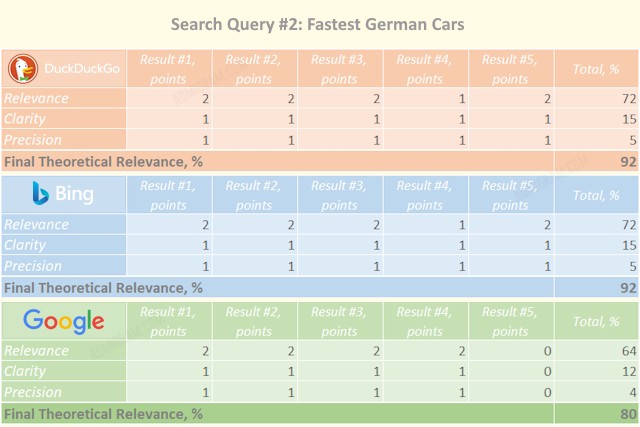
For example, with the query “Fastest German Cars,” we emphasized two critical aspects: speed and German manufacturers. This primary intent was weighted at 80% when evaluating results.
- 15% weight was assigned to clarity, meaning search results should be concise, well-structured, and free from unnecessary noise.
- 5% weight was given to personal precision, recognizing that search relevance is often subjective.
To ensure unbiased results, we blocked ads to eliminate potential distortions. Based on the findings, we created a scatterplot mapping the overall accuracy and relevance of search results.
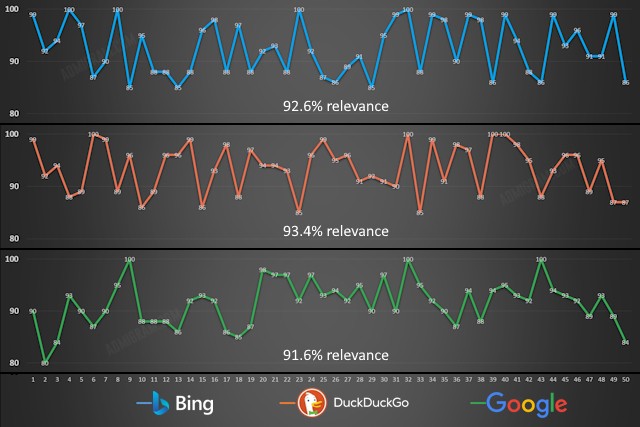
- Google: 91.6% relevance
- Bing: 92.6% relevance
- DuckDuckGo: 93.4% relevance
What Do the Results Show? Looking at the data, Google’s competitors are not far behind. In theory, you can find the same information on Bing or DuckDuckGo as you would on Google.
Practical Relevance of Search Engines (Real-World Tests)
Speed of Finding Information
Now, let’s get to the most interesting — and even more unexpected — part. Not only did we compare traditional search engines with their AI-powered competitors like ChatGPT, Grok, DeepSeek, and even TikTok, but we also disabled ad blockers to work with real, unfiltered search results.
For two weeks, the AdmiGram.com team searched for answers to various queries daily — some similar to those in our theoretical relevance tests, and others with more complex structures, requiring precise interpretation of search results.
For example: “Top 5 free Midjourney alternatives.”
The key focus here is five, best, and free alternatives. To ensure accuracy, we set a strict rule:
- The search had to deliver a useful answer within one minute.
- Just like in real life — if you can’t find what you need quickly, you get frustrated and move on.
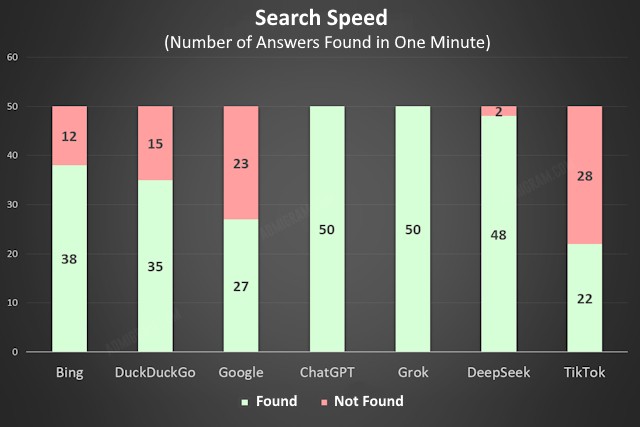
We created a visual comparison chart, showing which search engine helps you find what you need the fastest. The results? Traditional search engines struggle against AI.
And what’s even more surprising? A video-sharing platform like TikTok is competing head-to-head with Google when it comes to practical search speed.
Ease of Search Results
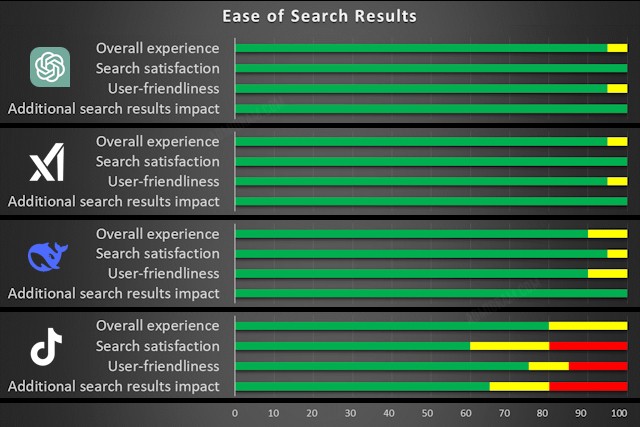
We also asked participants to rate their experience with each search engine, breaking it down into key factors:
- Additional search results impact (ads, news, distractions designed to keep you engaged)
- User-friendliness
- Search satisfaction
- Overall experience
Each factor was rated on a 10-point scale (where 10 = completely satisfied and 1 = completely unsatisfied). The catch? Each day, participants were only allowed to use one search engine.
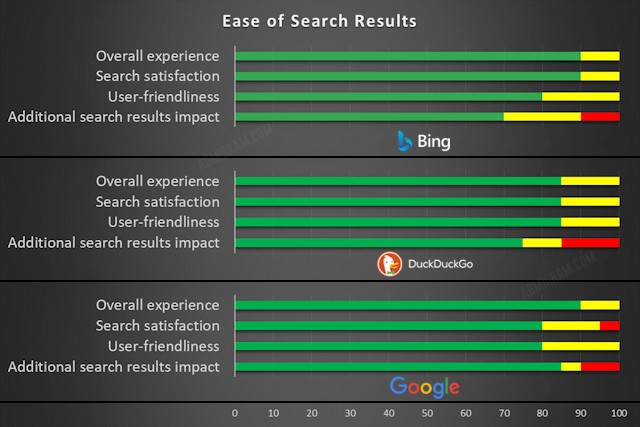
And guess what? Traditional search engines lost once again to modern AI-powered search tools.
So, Which Search Engine is Actually Better?
You’ve seen the test results, but let’s think about this:
- Some participants had never used anything other than Google before this test.
- They were surprised to discover that DuckDuckGo and Bing can sometimes provide better results than Google.
- And most importantly — after our research, many former Google-exclusive users started using DuckDuckGo, ChatGPT, and even TikTok to find answers.
What Does This Mean?
We’re living in a time of radical change in search technology. Even now, basic tests show that old-school search engines are losing to new, concise, visual responses — for example, in TikTok. Try searching for mojito recipes on Google vs. TikTok, and you’ll see what we mean.
And when it comes to AI-powered search (ChatGPT, Grok, DeepSeek), no traditional search engine can compete in terms of speed and convenience. AI’s response consistency is nearly perfect. For Google, Bing, and DuckDuckGo, this is a huge problem — one that looks a lot like what Lycos and AltaVista faced before they disappeared.
Are you still Googling?
image on top: jeshoots / Unsplash