Space isn’t just stars, planets, and galaxies — it’s a mystery machine that constantly baffles scientists and sparks our imagination. From the vast emptiness of the universe, we occasionally receive signals that science can’t fully explain — strange bursts and blips that make us question everything we know about reality.
AdmiGram.com explores five of the weirdest cosmic signals ever detected — phenomena that suggest the universe may be hiding far more than it reveals.
5 Strangest Signals Ever Detected from Space
The “Wow!” Signal (1977)
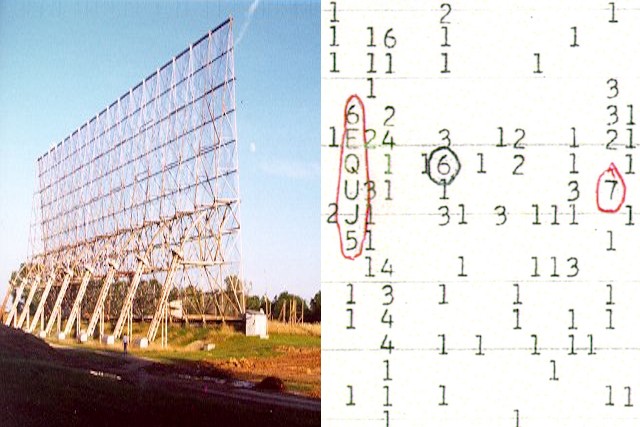
In 1977, astronomer Jerry Ehman was scanning the skies with Ohio State’s Big Ear radio telescope when he picked up a powerful signal that lasted just 72 seconds — but was so extraordinary, he circled it on the printout and scribbled “Wow!” next to it. This narrowband signal, transmitted at 1420 MHz — the natural emission frequency of hydrogen — didn’t resemble any known natural source. It was too structured to be random noise, yet too brief to trace back to a source.
To this day, scientists debate whether the “Wow!” signal came from an alien civilization or some rare cosmic event, like a comet flare. Decades later, it has never repeated. What if that was someone — or something — deliberately saying “hello”… and we just missed the message?
Fast Radio Bursts (FRBs)
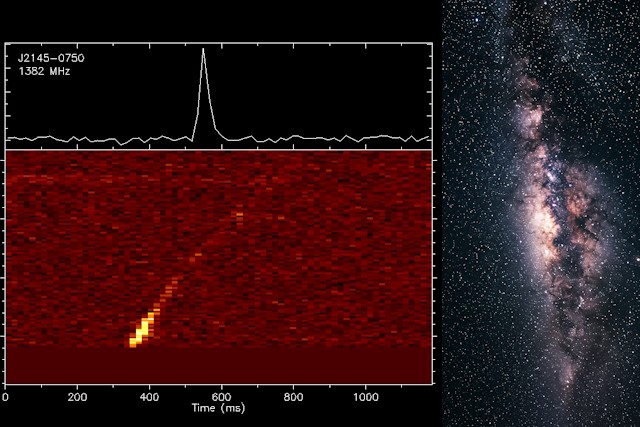
Since 2007, astronomers have been detecting incredibly brief but powerful radio pulses known as Fast Radio Bursts (FRBs). Lasting only milliseconds, these bursts release more energy than hundreds of suns — and many originate from galaxies billions of light-years away. Most FRBs are one-off events, but some, like FRB 121102, repeat unpredictably — and a few even follow regular cycles.
What causes them? Theories range from colliding neutron stars to exotic alien transmitters. The fact that some of these bursts show clockwork-like precision is especially eerie. Could they be artificially generated, cleverly disguised as natural occurrences?
The Cosmic Microwave Background’s Anomalies
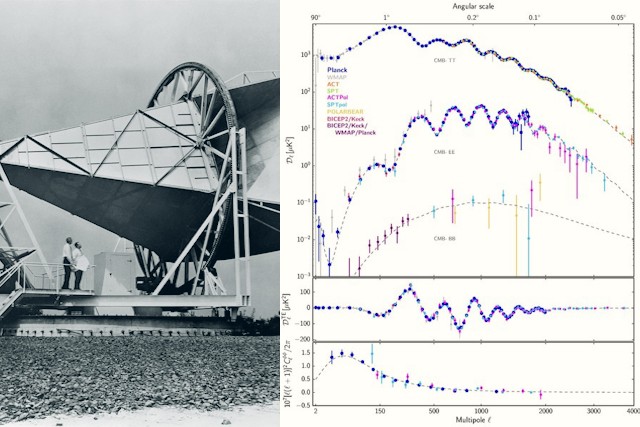
The Cosmic Microwave Background (CMB) is the afterglow of the Big Bang — a nearly uniform radiation field that fills the entire universe. But hidden within this “static” are a few unsettling anomalies. One is the “Cold Spot,” a region significantly cooler than the surrounding CMB. Another is the so-called “Axis of Evil” — a strange alignment of temperature fluctuations with the plane of our Solar System.
These features don’t fit well into our standard cosmological models. Some researchers speculate that they might hint at something truly wild — like our universe colliding with another in a multiverse scenario. Others think it’s just statistical noise. But what if these patterns are subtle hints that our universe is part of something far bigger… and far weirder?
The Mystery of Tabby’s Star (KIC 8462852)
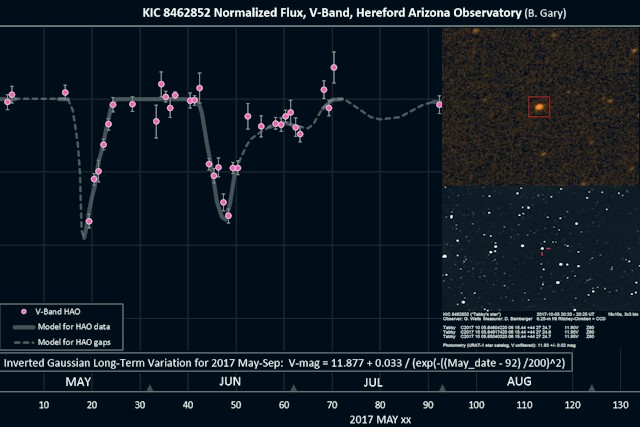
In 2015, the Kepler space telescope recorded bizarre dimming patterns from a star known as KIC 8462852 — better known as Tabby’s Star. Instead of the usual smooth dips caused by orbiting planets, its brightness dropped chaotically — sometimes by more than 20% — with no apparent rhythm. Initial theories included a swarm of comets or clouds of cosmic dust, but none fully explained the data.
That’s when a bold idea emerged: what if we’re seeing part of a Dyson Sphere — a colossal energy-harvesting megastructure built by an advanced civilization? While that sounds like pure sci-fi, no better explanation has emerged. Maybe, just maybe, we’re witnessing something beyond our wildest imagination.
The Signal from Proxima Centauri (BLC1)
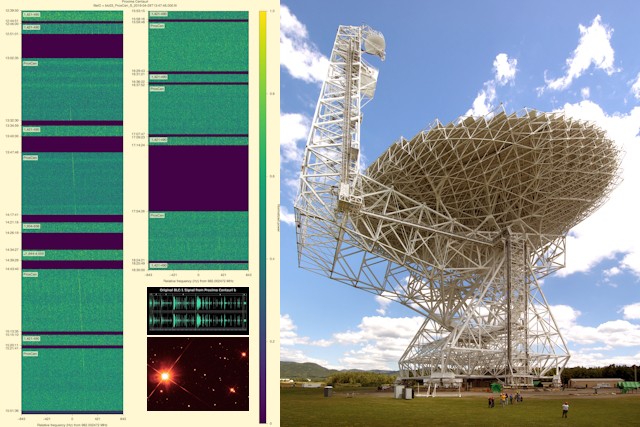
In 2019, scientists working with the Breakthrough Listen project picked up a narrowband radio signal at 982 MHz — coming from the direction of Proxima Centauri, the star system closest to Earth. The signal, labeled BLC1 (Breakthrough Listen Candidate 1), was sharp, clean, and didn’t resemble any Earth-based interference from satellites or aircraft.
Although later analyses suggested it could have been Earth-based after all, no conclusive explanation was ever found. Proxima Centauri is just 4.2 light-years away — a stone’s throw in cosmic terms. The idea that something (or someone) nearby might be trying to make contact? Goosebumps.